← All stories

1626–1654

The fort: a frontier on inhabited land.

Long before the dam or village, this was inhabited land. Bratsk’s history begins with an encounter, and conflict, between different worlds.

01

Before the Russian fort

The Angara connected Buryat and Evenki lands. For servicemen arriving from Yeniseisk, it offered a route to new territories and fur tribute. For local communities, armed newcomers disrupted established life. Bratsk’s name derives from an old Russian designation for Buryats, not from a later Soviet ideal of brotherhood.

02

From winter camp to fort

A winter camp of Maxim Perfilyev’s party is recorded in 1626; 1631 became the conventional founding date of the fort. The outpost supported state expansion, tribute collection and further expeditions. Early fighting and destruction challenge any idyllic account of settling an empty landscape.

03

Why relocation dates differ

A. A. Pavlov distinguishes a fort near Padun, a new Oka right-bank fort in 1636 and the 1654 move. A widely circulated account instead includes a 1648 relocation, also repeated by the Academy of Sciences. These are different documentary reconstructions, presented here as such rather than forced into one certain sequence.
Sources for this story

  1. Three forts: A. A. Pavlov’s study ↗
  2. Dating the towers of Bratsk Ostrog ↗
  3. A history of Bratsk ↗

Photographic records

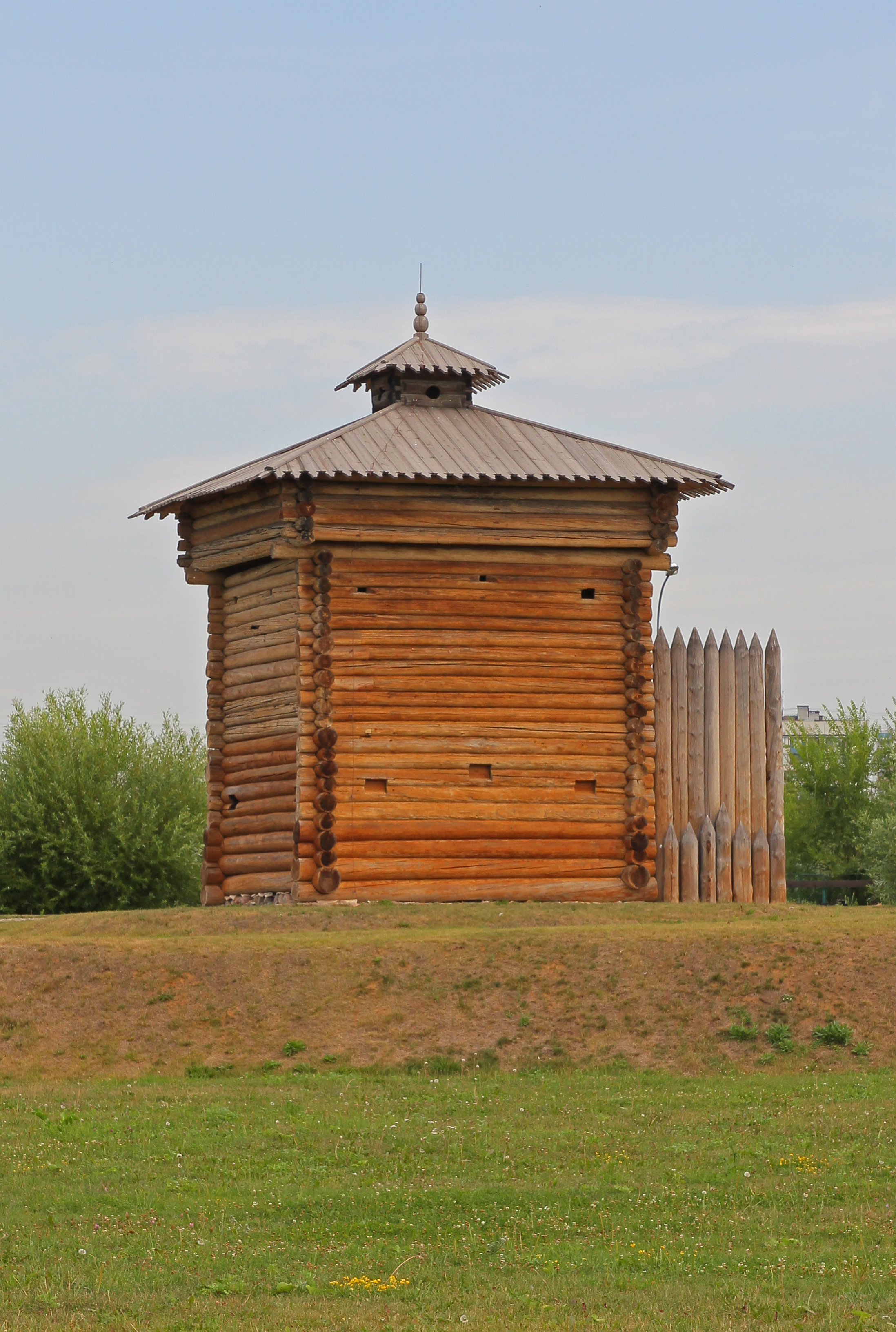
26 July 2011. The relocated tower in Kolomenskoye, Moscow. A modern photograph of a historic structure.
А.Савин, Википедия / A.Savin, Wikipedia · CC BY-SA 3.0 · Original ↗

Dates in this story

Origins

A winter camp below the rapids

Maxim Perfilyev’s party establishes a winter camp below the Bratsk rapids. It precedes the 1631 fort, not the founding of the modern city.

Read the full story ↗
Origins

A fort on the Angara

Maxim Perfilyev’s expedition establishes Bratsk Ostrog, a fortified outpost of Russian expansion along the Angara.

Read the full story ↗
Origins

The fort meets resistance

The early forts become sites of conflict with local Buryat groups. Reconstructions differ on destruction and rebuilding dates; this was not an uninhabited wilderness.

Read the full story ↗
Origins

An alternative relocation chronology

A. A. Pavlov identifies a new fort on the right bank of the Oka in 1636. This scholarly reconstruction must not be silently merged with the commonly cited 1648 relocation.

Read the full story ↗
Origins

A new site by the Oka

Dmitry Firsov relocates the fort near the Oka mouth. Researchers continue to refine the history of its early sites.

Read the full story ↗