The history of the holiday home and sanatorium beside Zyaba Bay: its 1966 opening, mineral water, guests’ memories, children’s camp and attempts to revive the well-known retreat.
21 CHAPTERS / ABOUT 10 MIN READ
1964
1 March: construction begins
1966
26 July: the holiday home opens
1981
Guests describe their stay in the city newspaper
2022
Na Vzmorye children’s camp programme
Article contents +
A Siberian retreat beside a new sea
Bratskoye Vzmorye emerged in a city accustomed to ambitious construction. A holiday home, later a well-known sanatorium, took shape beside the artificial sea, with accommodation, treatment facilities, dining and a daily life away from industrial sites. Residents associate it with family holidays, work and summers at a children's camp.
Its history connects several eras: 1960s construction, trade-union holidays, expanding sanatorium services, financial difficulties and attempts at renewal. Surviving records reveal a particular institution, its people and its practical operation behind the broad word “resort”. The meeting of forest and water helps explain why the place retains importance for the city through closure and changing development plans.
≤ 2019
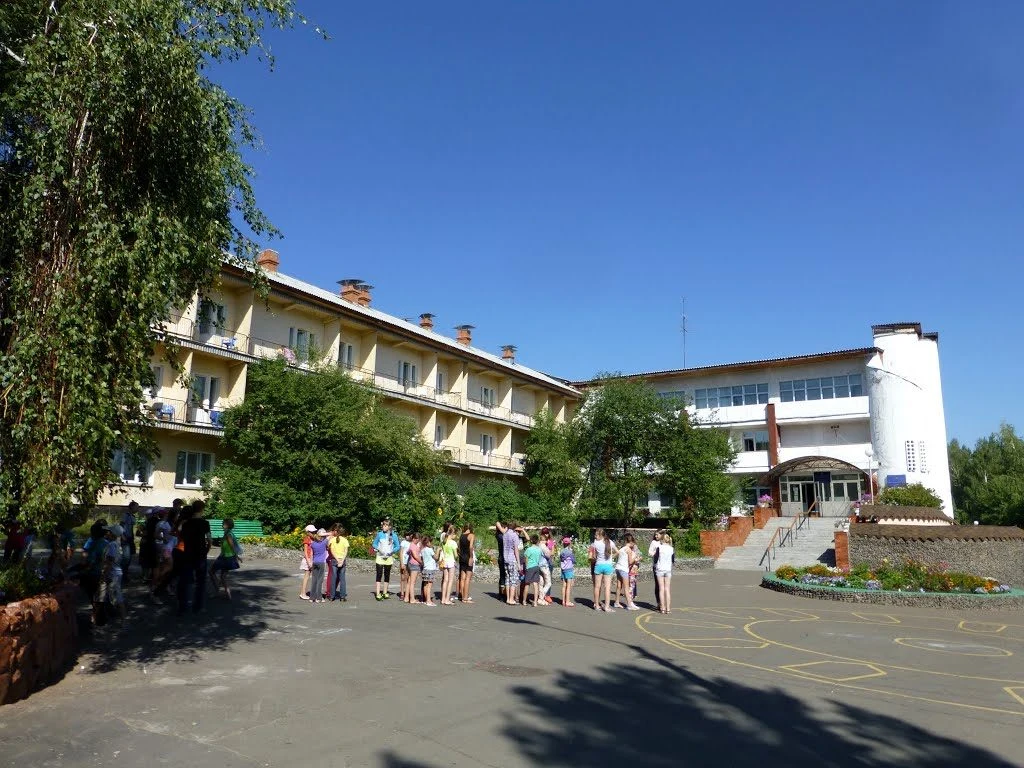
Bratskoye Vzmorye buildings
Lead illustration in TK Gorod’s report of 23 April 2019, showing the buildings and grounds. The photograph’s exact date is not supplied. It is neither an opening-year image from 1966 nor confirmation of present guest operations.
The complex stands beside Bratsk Reservoir near Zyaba Bay. Reference descriptions place it about sixty kilometres from Bratsk's Central district and roughly nine from the dam. These figures convey its distinctive setting: closely connected with the city, yet located in a separate wooded shoreline environment.
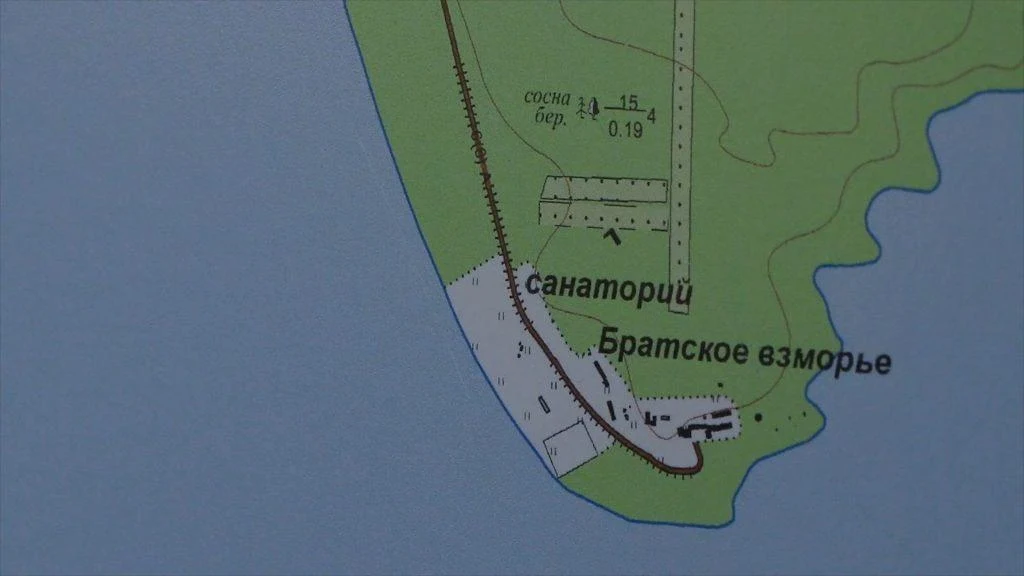
The bay, public beach, dachas and sanatorium grounds have different boundaries and purposes. Historically, “going to Zyaba” and “staying at Vzmorye” described different holidays. The map shown in the 2024 report illustrates the buildings' position beside the water. It is a location illustration rather than a current plan of public access, roads or reconstruction areas.
2024 · публикация / publication
The sanatorium on a map
Map shown in the municipal press-centre report of 28 February 2024. It illustrates the complex’s shoreline location, not a published reconstruction master plan or current access map.
The 1964 chronicle dates the start of construction to 1 March and records an initial plan for 250 places. Work began while Bratsk Reservoir was still filling: the new waterscape and its future holiday home developed almost together.
For the rapidly growing city, this was social infrastructure. Builders and industrial workers needed homes, cultural facilities and opportunities to rest. The broad reservoir shore offered a setting nearby. “Vzmorye”, meaning a seaside or seashore, expressed a new way of seeing the transformed Angara: the immense construction campaign had also created a destination for holidays and visits from elsewhere.
The Central City Library's commemorative calendar dates the opening of the trade-union holiday home to 26 July 1966. The local chronicle gives the same date and lists 180 places for its first stage, fewer than the 250 in the initial construction plan.
These figures describe different stages rather than necessarily contradicting each other. Planned capacity and the first operating stage are separate measures. The year 2026 marked sixty years since the first guests arrived. Behind that anniversary lies a concrete change: buildings became a functioning holiday destination, with visitors, service staff, daily routines and the first experiences on which Vzmorye's reputation would grow.
The description “VCSPS holiday home” places Vzmorye's beginnings within the Soviet trade-union holiday system. A voucher meant an organised stay: accommodation, meals, a defined holiday period and the institution's daily programme. Guests shared places for meetings, walks and activities.
This differed from an independent outing to the same forest and water. A visitor entered the work of a large team: reception, room allocation, meals, building maintenance and care of the grounds. Everyday staff performance mattered greatly. The resort's history therefore includes more than construction dates and directors' names; it includes the labour that turned a voucher into an enjoyable stay.
The library calendar describes two accommodation blocks, a treatment department and a dining hall joined by warm indoor connections. This arrangement had a practical purpose for year-round operation in Bratsk: guests could reach the main facilities without repeatedly going outside into the cold.
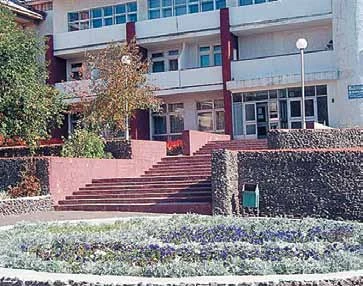
An entrance photograph in the older catalogue shows the architecture of everyday sanatorium life: steps, flowerbeds, large windows and several storeys. The buildings provided accommodation within a wider treatment and domestic-service system. Later reconstruction consequently involves connections between rooms, passages and engineering networks. Renovating one room is a smaller task than restoring the dependable operation of the entire complex.
≤ 2011
Entrance to a Bratskoye Vzmorye building
Illustration from the SOGAZ sanatorium catalogue: steps, flowerbeds and a building facade. The catalogue file is dated 2011; the exact photograph date is not supplied. Printed page 310, PDF page 311.
Its own mineral water became one of the resort's best-known features. The SOGAZ catalogue associates Bratskaya water with boreholes Nos. 1 and 2 within the sanitary protection area. The 2019 report places drilling and development of the resource in 1975–1985.
This mattered to the institution's changing role: specialised rooms and equipment developed alongside holidays beside the reservoir. Underground mineral water and reservoir water are different resources and should not become one story about a “healing sea”. Promotional assessments in older descriptions are part of the resort's reputation history, rather than evidence for treatment promises or guidance on drinking the water independently.
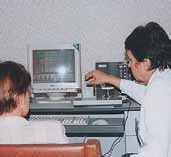
The older catalogue lists exercise therapy, massage, physiotherapy, baths and a drinking-water facility. It records the resort's historical service profile: accommodation combined with appointments and prescribed procedures, giving a stay an organised clinical routine.
The small treatment-room photograph preserves one aspect of that daily environment. Equipment, professional staff, appointment schedules and connections to accommodation all belong to the story. The catalogue records an offer at a particular time. It establishes neither current operation of every room nor the effectiveness of individual methods. These details explain the institution's past rather than provide treatment selection advice.
≤ 2011
Treatment room in the older catalogue
Small treatment-room photograph in the catalogue’s Bratskoye Vzmorye entry. It documents an earlier equipment and staff setting, rather than establishing current service availability.
In 2019, Alla Tirskikh revisited a holidaymakers' letter published in Krasnoye Znamya in 1981. Its signatories, Ust-Ilimsk pulp-complex engineer N. Vologzhin and Irkutsk State University representative S. Smirnov, met at Bratsk airport on their way to the resort.
They remembered driver L. Trinkunas welcoming them and showing Energetik and Ivan Naimushin's grave en route. Their holiday became an introduction to Bratsk. The account offers an outside view in which hospitality began before check-in, linking the city and its sanatorium in one remembered journey.
Valentina Kuleshova-Timusyak's recollections in Znamya preserve an episode from preparations for opening. She describes working with Komsomol members from the chief power engineer's department and other organisations. The testimony restores individual participants to the institutional milestone.
Before the first visitors arrived, many rooms and services had to be ready. Such memories connect the holiday home with the teams building Bratsk. For city workers, it emerged as another shared undertaking: alongside industrial and residential projects came a place intended for their own leisure and for guests.
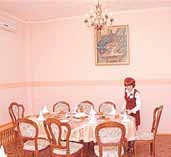
A sanatorium stay included its own leisure world. The older catalogue mentions a library, children's room, billiards, sports facilities and equipment hire. They help reconstruct time between walks and appointments, when guests could read, socialise or exercise within the grounds.
The small dining-interior photograph also recalls kitchen and service work. Meals were a continuing part of a stay, requiring supplies, staff and daily organisation. Such ordinary details form resort memories: an interior, the walk from a room to the dining hall, or a favourite reading place may remain as vivid as the reservoir glimpsed through trees.
≤ 2011
A dining interior
Illustration from the same SOGAZ catalogue, showing laid tables and a staff member in a dining space. The source identifies neither the room nor the exact shooting year.
The Health Ministry describes Bratskoye Vzmorye as a climatic health-and-recreation locality on the reservoir shore amid mixed woodland. This setting was part of the holiday concept: walks began near the accommodation, while the shore offered an open horizon and a change of scene.
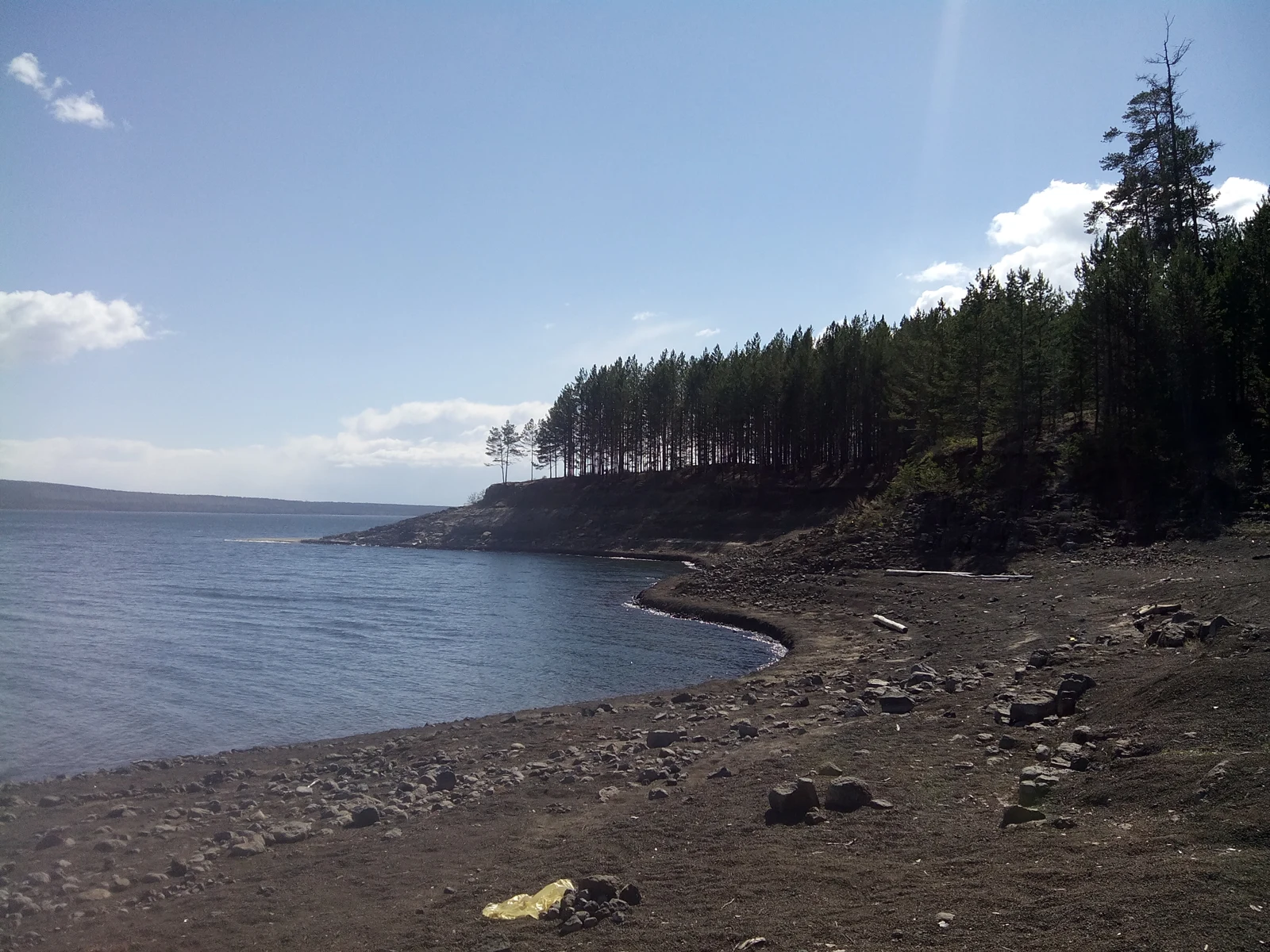
Photographs taken on 17 May 2015 show the landscape between seasons: cool-looking water, exposed shore and wooded slopes. They reveal the place beyond the familiar imagery of crowded summer beaches. The waterline changes with reservoir levels, however, so an older photograph need not match its present position.
2015
The Vzmorye shore in May
17 May 2015: water, exposed ground and a wooded headland. The source identifies the Bratskoye Vzmorye natural area. This is an off-season view, not evidence of an operating equipped beach. Resized and converted to WebP.
Year-round operation distinguished Vzmorye from a seasonal beach outing. Winter required heating, dependable passages, grounds maintenance and supplies. Summer changed the pattern of walks and children's activities, but accommodation and public facilities still needed continuous care.
This imposed substantial practical demands. Buildings, networks, dining and clinical rooms had to work together. Later debates about the resort's future consequently involved more than the attraction of a shoreline property. Keeping a sanatorium meant maintaining a complete service system through a Siberian year. Warm connections and engineering services were integral to that arrangement rather than minor details behind an attractive facade.
Bratskoye Vzmorye was also an employer, bringing together medical workers, cooks, administrators, cleaners, repair teams and technical staff. The 2018 report on operating difficulties records a boiler house, garage and two staff residential buildings alongside the accommodation blocks.
This side of the story can disappear behind the word “holiday”. Visitors used the grounds as a temporary home; employees experienced them as everyday life. Heating and network conditions affected both. A crisis or revival therefore changed more than visitor numbers: it influenced work and the lives of people connected with the place over many years.
TK Gorod's report of 23 April 2019 linked a new phase to 2017. Director Vasily Gobzhila described difficult operating conditions and bankruptcy proceedings followed by attempts to restore activity. Journalists saw a refurbished children's block and reported a substantial children's arrival after a prolonged interruption.
The report records both actions and expectations at that time. Completed repairs, operating treatment rooms and further modernisation plans represent different stages. Later closure reports show a more complicated trajectory than a single successful relaunch. Repeated attempts to restore a familiar city destination are themselves an important part of Vzmorye's history.
A detailed record survives of the children's side: the Na Vzmorye camp programme compiled by Elena Falunina and published by Bratsk State University in 2022. Its title page names the university and Bratskoye Vzmorye LLC. The programme concerns cultural heritage and folk arts.
It reveals holidays from the educators' perspective: counsellors, temporary children's groups, activity planning and professional preparation. Children's recreation required more than accommodation places; it needed a programme, an adult team and daily communication. Dated to the 2022 season, the document preserves evidence of that work as a distinct part of the complex's history.
Bratsk State University connects its teaching-oriented student teams with local holiday institutions, including Bratskoye Vzmorye. The 2022 programme explicitly addresses educators and student counsellors undertaking practical training at the sanatorium.
The resort thus participated in the city's educational life. Students gained experience organising temporary children's groups, while children had a team responsible for their activities. A leisure destination also became a place for professional development, connecting the university, family memories and people who might later work in schools or other institutions. The programme makes that relationship more tangible than the general word “camp”.
On 28 February 2024, Bratsk's municipal press centre reported a reconstruction meeting involving city officials and project representatives. Grand Baikal director Viktor Grigorov spoke about an assembled project team and design preparation.
The announced concept involved extensive building renewal, a changed exterior and grounds for family recreation across the seasons. The company intended to prepare the sanatorium design by summer 2024. Those dates record statements at the meeting. The 1 March report explicitly described the sanatorium as closed. Discussion and design preparation do not establish completed reconstruction or resumed guest operations.
The 2024 announcement distinguished sanatorium reconstruction from wastewater facilities. The city administration would handle design and modernisation tasks for the treatment works, with planned funding through Bratsk's individual development programme. Renewal of the resort itself was associated with the owning company.
This helps explain the complexity of revival. New interiors need functioning networks and supporting infrastructure, especially beside a large reservoir. At the meeting, summer 2025 was named for completion of the wastewater reconstruction design. That is a stated design deadline, not evidence that every facility had been built and commissioned by then.
2015
An exposed stretch of shore
17 May 2015. View along the resort’s natural shoreline area. Reservoir levels and the waterline change by season and year. Resized and converted to WebP.
A commercial procurement notice published on 1 November 2025 concerns technical-client services for reconstruction in 2026. It names Project Vzmorye LLC as the customer, providing a documentary trace of continuing project activity after the 2024 public discussions.
The notice gives no reopening date and does not establish that buildings are ready for guests. The material checked for this article contains no confirmed announcement of full guest operations resuming by 19 October 2026. Older travel listings with prices and treatments should therefore be understood in their historical context, while actual visiting arrangements need confirmation from the organisation responsible for the complex.
Bratskoye Vzmorye's history survives through an opening date, an older catalogue, guests' letters, a camp programme, shoreline photographs and reconstruction records. Together they reveal a place where city work, leisure, education and life beside the water met over decades.
For families it might mean a child's first independent holiday, an adult stay, work in a building or an ordinary walk. For Bratsk it represented the creation of a resort beside its new sea and subsequent attempts to sustain it through changing circumstances. The articles on Zyaba and Bratsk Reservoir place the complex back within the surrounding landscape whose scale and beauty helped inspire its original purpose.
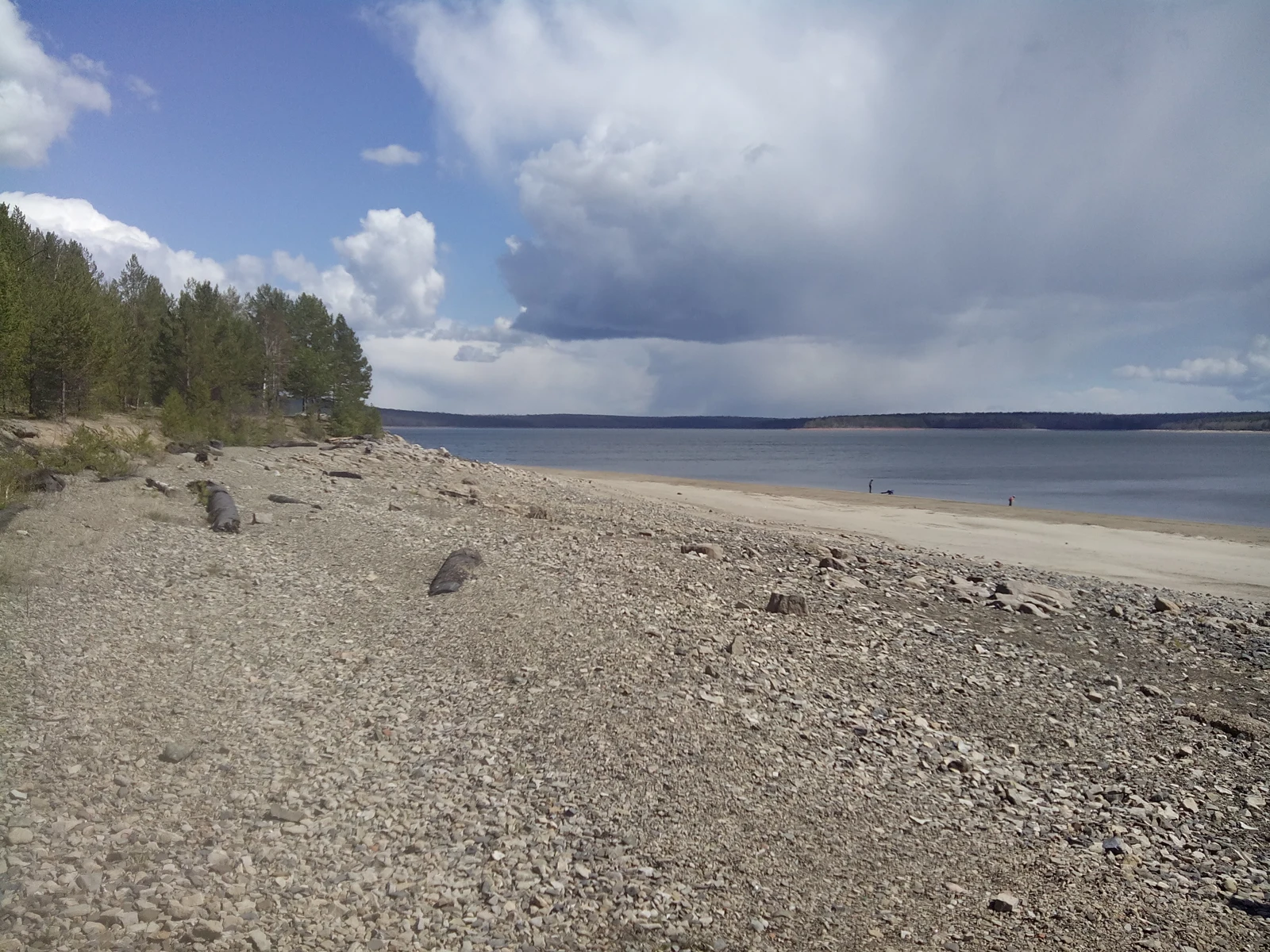
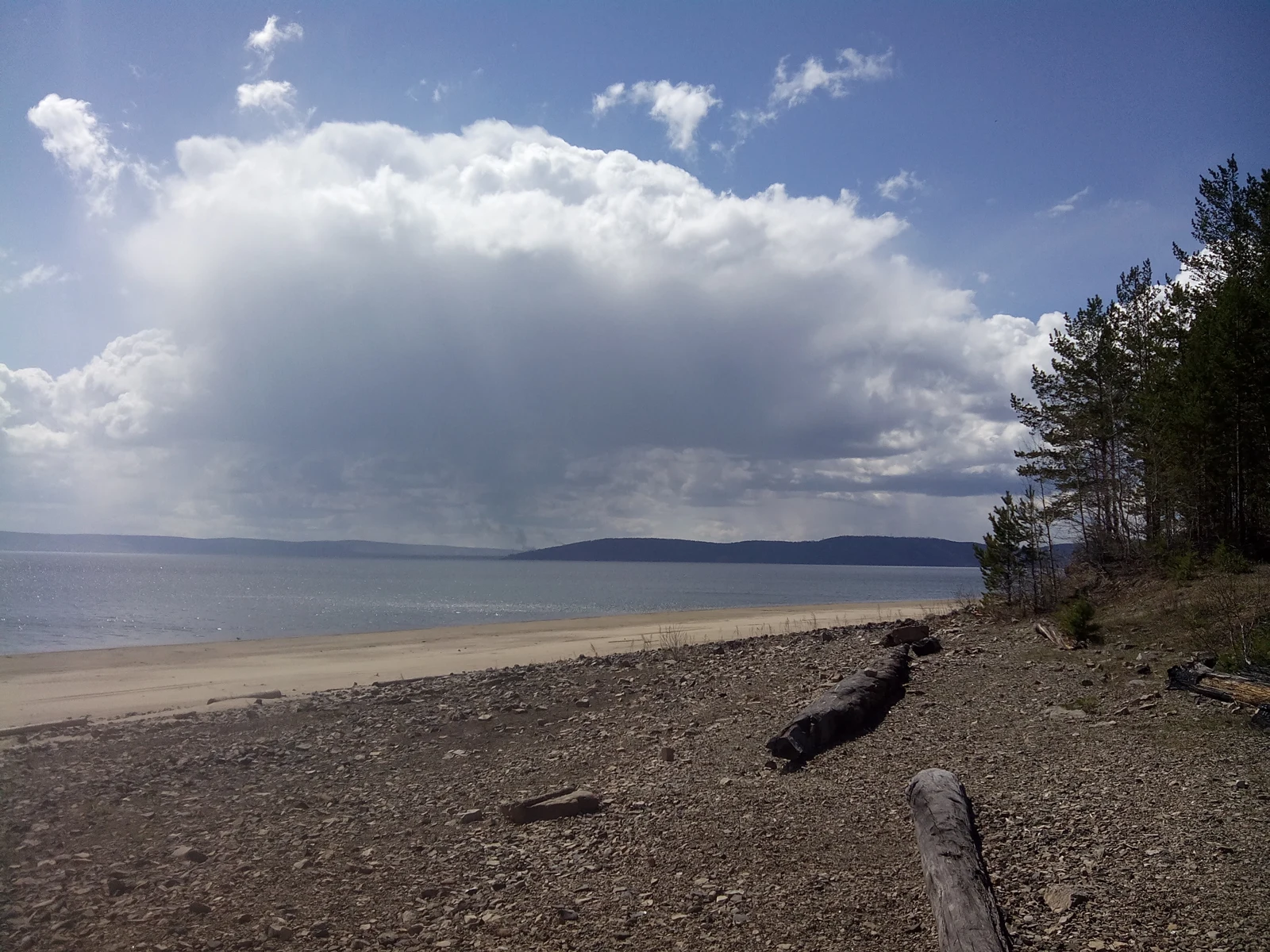
2015
Water, clouds and a wooded shore
17 May 2015. Landscape documented in the Bratskoe Vzmorye Resort collection on Wikimedia Commons. The date is the shooting date; this is not a view of the 2020s reconstruction. Resized and converted to WebP.
Checked: 19 October 2026. This is a historical article. Older catalogue services and the 2022 camp programme are not presented as current offers. Dated reconstruction plans are distinguished from confirmed outcomes; the checked material contains no confirmed announcement of full guest operations resuming. Mineral-water and treatment references describe institutional history, not medical recommendations.