BRATSK HYDRO / SPECIAL FEATURE

The history of Bratsk HPP.

From a river of rapids to a hydroelectric complex and an industrial city. Key stages through 1991.

01Before 1954

The river before the dam

Plans to harness the Angara predated the major construction project. The Hydropower of Russia Association dates an early Bratsk HPP design to the 1930s. Site investigations began in 1949, followed by a preliminary design in 1953.

The river was already lined with villages, livelihoods and transport routes. Choosing the dam site would reshape the city and its shores. The station’s story therefore belongs beside the history of old Bratsk and resettlement: behind the term “reservoir” were places where people had lived before construction.
021954–1955

First, build the construction site

The construction decision came in 1954, followed by the organisation and work base. Roads, homes, workshops and supply routes were needed before the main structures could rise. Zelyony Gorodok near Padun became an early point in this new geography.

Work spread across both banks, alongside settlements that would become parts of Bratsk. The modern city gained city status in December 1955, with the dam itself still a vast undertaking ahead.

031957

Closing the river from the ice

On 30 March 1957, builders closed the right-bank channel from the ice to create a construction pit. The operation became an enduring image of the Bratsk project. It helped prepare the foundation pit; it did not mean the dam was finished.

Further work required cofferdams, diversion of the flow, drainage and electricity supplies. Behind the dramatic closure lay a sequence of engineering operations.

041958–1960

Concrete, shifts and installation

The first foundation concrete was laid on 12 March 1958. On 19 June 1959, the Angara was finally closed and its flow diverted through temporary openings in the growing dam. These were distinct from the 1957 closure from the ice.

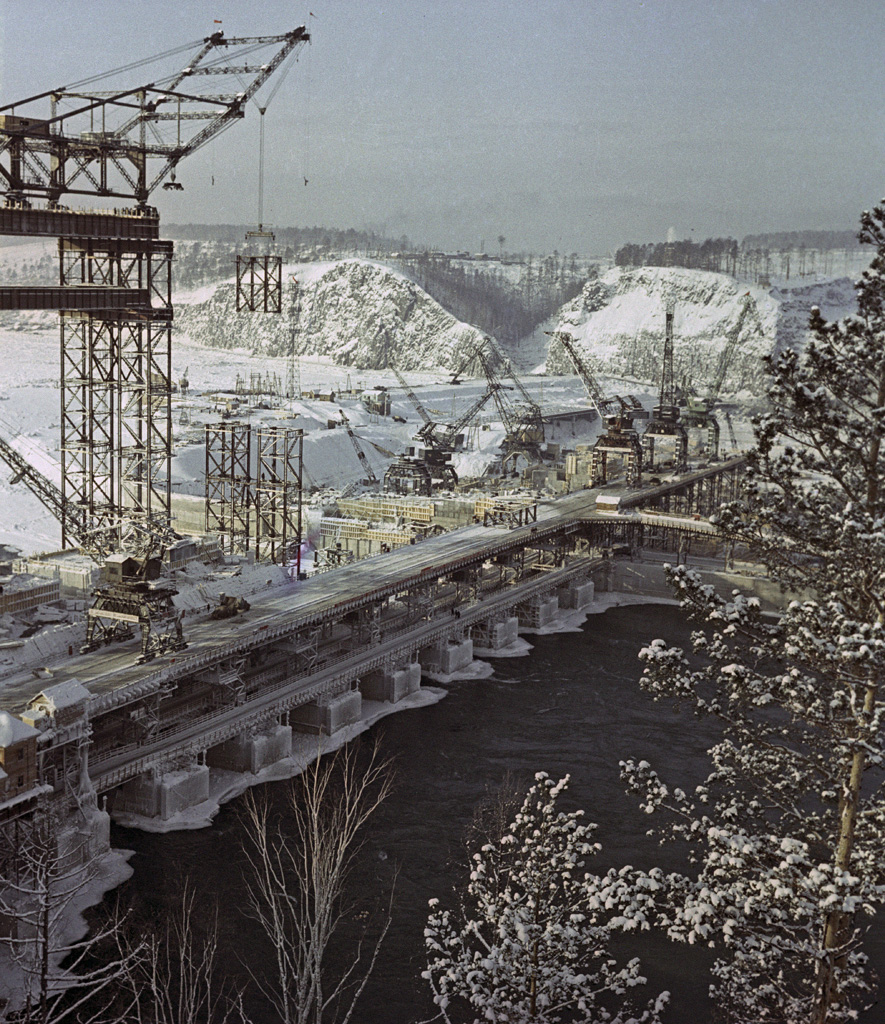
Photographs from 1960 show cranes, separate sections and unfinished structures. Equipment arrived and installation began alongside construction. Each system had its own completion date as a building site gradually became a power station.

1 October 1960. Bratsk dam under construction.
1960

Autumn at the construction site

1 October 1960. Bratsk dam under construction.

Алексей Бушкин / Alexey Bushkin · Wikimedia Commons / РИА Новости
CC BY-SA 3.0 · Original ↗

051961

Water redraws the map

Filling the reservoir transformed the landscape. Houses and settlements were moved out of the inundation zone, while selected historic buildings were preserved separately. New shores divided places once connected by the river.

For resettled families, it meant losing familiar surroundings and rebuilding everyday life. For the city, it created the Bratsk Sea and a new geography of distances. Those consequences reach well beyond turbine specifications.

0628.11.1961

First power was not the finish

The first 225 MW unit came under commercial load on 28 November 1961, at a ceremony attended by Nikita Khrushchev. The project was supplying electricity while the hydroelectric complex remained unfinished.

This is why the station has several key dates: work began, first power, the last unit’s start and final acceptance. Each marks a different stage.

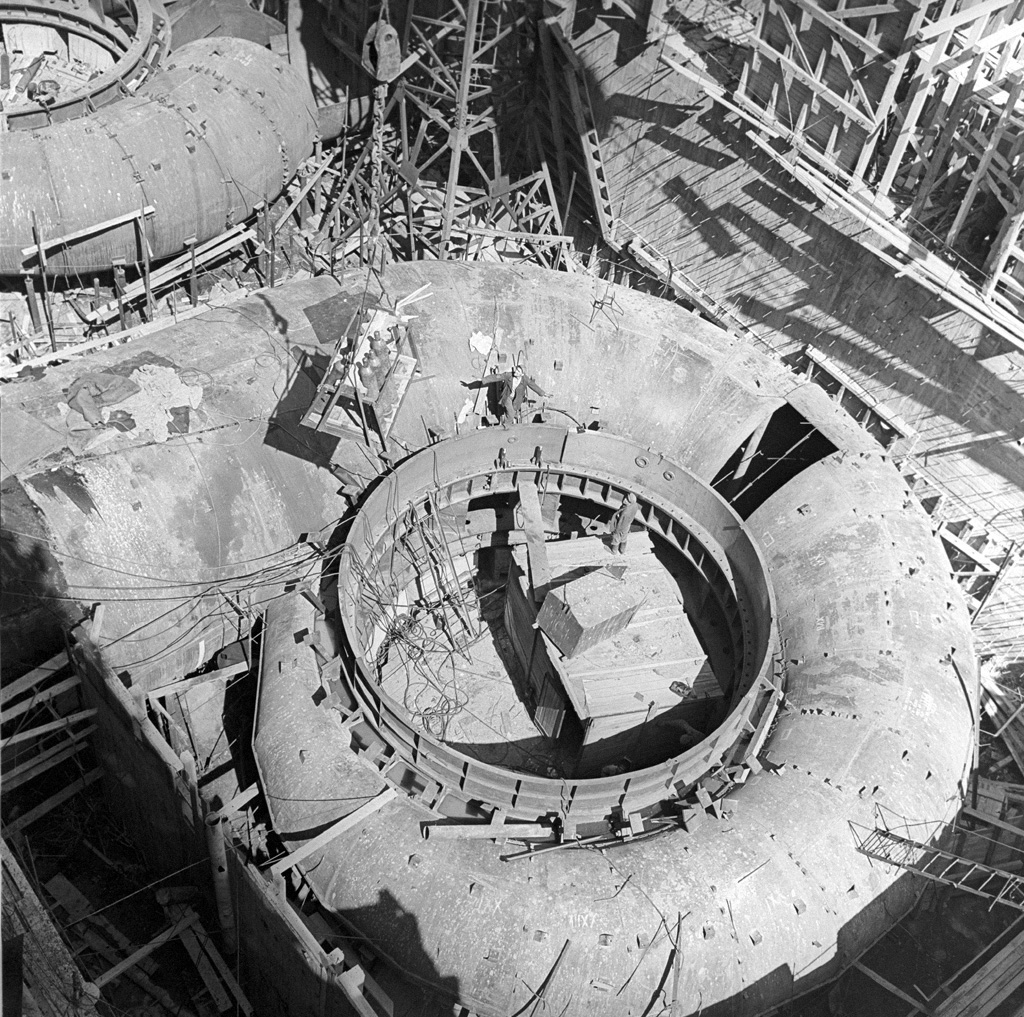
1 March 1961. Equipment installation at Bratsk dam.
1961

Hydroelectric equipment

1 March 1961. Equipment installation at Bratsk dam.

Валерий Шустов / Valeriy Shustov · Wikimedia Commons / РИА Новости
CC BY-SA 3.0 · Original ↗

071964–1967

Eighteen units. One complex

The central control room opened in 1964. In 1965, trains crossed the crest, and the dam became a route for rail and road traffic, joining the everyday transport connections between parts of the city.

The eighteenth unit started on 14 December 1966. The state commission accepted the complex for permanent operation on 8 September 1967, almost six years after first power.

081967–1991

After construction, the life of a city

The station became an energy foundation for industrial Bratsk, particularly aluminium production. Workforces, residential districts and memories of the pioneers grew around it. Energetik, Padun and the right bank retain different traces of that shared history.

The project entered songs, documentary films and Yevtushenko’s poem. By 1991, it was both an operating power station and a symbol of the city, with its builders continuing to tell its story. Contemporary records and specifications appear in a separate section.

From construction to operation

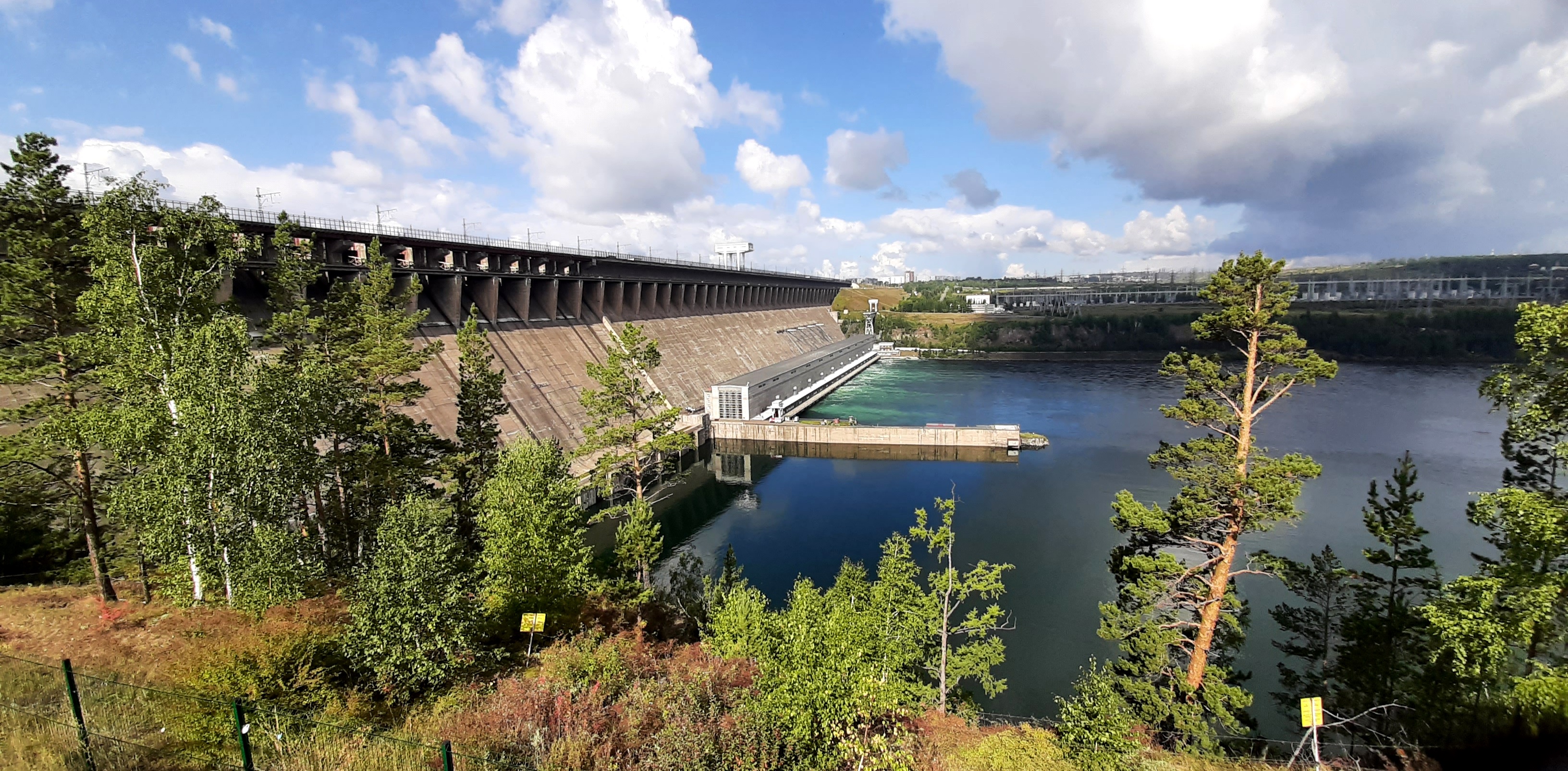
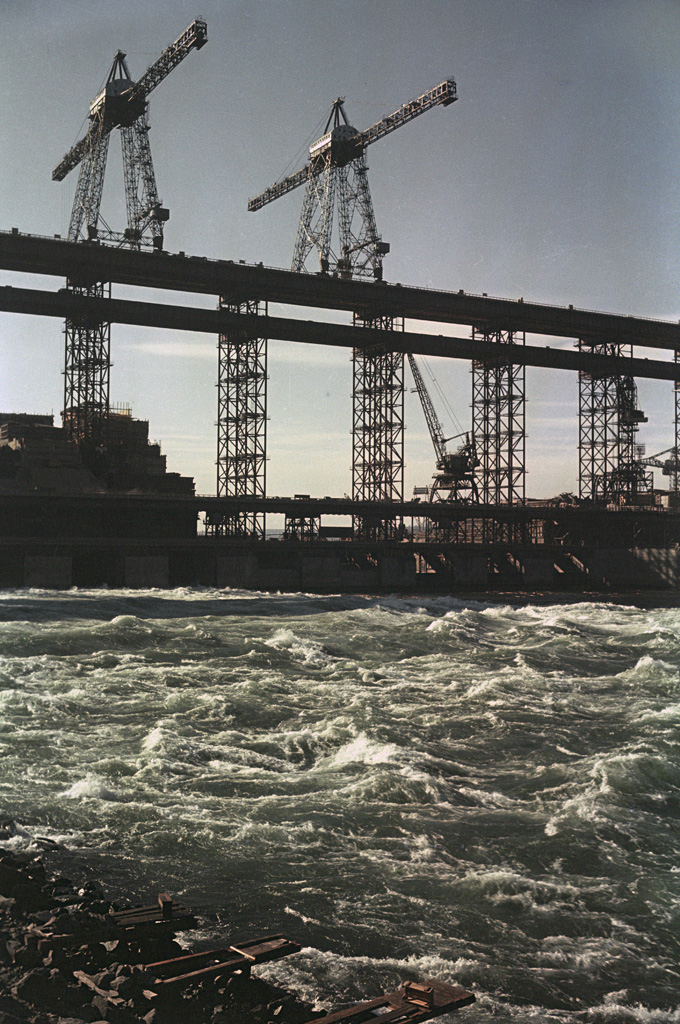
1960 and 2021. The same hydroelectric complex in different eras, photographed from different viewpoints.

1 March 1960. Building the Bratsk dam.
1960

Construction panorama

1 March 1960. Building the Bratsk dam.

Макс Альперт / Max Alpert · Wikimedia Commons / РИА Новости
CC BY-SA 3.0 · Original ↗

18 August 2021. A modern view of the Bratsk dam; not an archival photograph.
2021

The dam decades later

18 August 2021. A modern view of the Bratsk dam; not an archival photograph.

Andrijko Z. · Wikimedia Commons
CC BY-SA 4.0 · Original ↗

More construction photographs and films ↗

Sources for this section

Information checked on 18 October 2026. Photograph dates appear in captions.