← Explore the cityBRATSK / PEOPLE & PLACES

Lyceum No. 1: the story of a Bratsk school.

From a technical lyceum connected with Bratsk Industrial Institute in 1990 to engineering teams, research projects and a school museum. Teachers, traditions, robotics and relationships with the university and industry, explored in 30 chapters.

30 CHAPTERS / ABOUT 15 MIN READ
1990

The lyceum’s founding year

1999

Permanent building on Pogodayeva, according to its anniversary history

6

Regional graduate-competitiveness place, RAEX 2026

8

Street number on Pogodayeva

Article contents

A lyceum in Energetik

Lyceum No. 1 stands at 8 Pogodayeva Street in Energetik. Its formal identity is a municipal general-education school of the city of Bratsk. It has its own administration and educational life rather than being a university faculty, although its relationship with BrSU runs through its history.

Several Bratsk stories meet here: mathematics and physics teaching, the university environment, industrial employers and families choosing a school. The lyceum is interesting because of that combination. Its history extends beyond examination results to teaching methods, pupil projects, a museum, volunteering and relationships with city organisations. The following chapters describe specific episodes, keeping historical figures separate from present-day conditions.
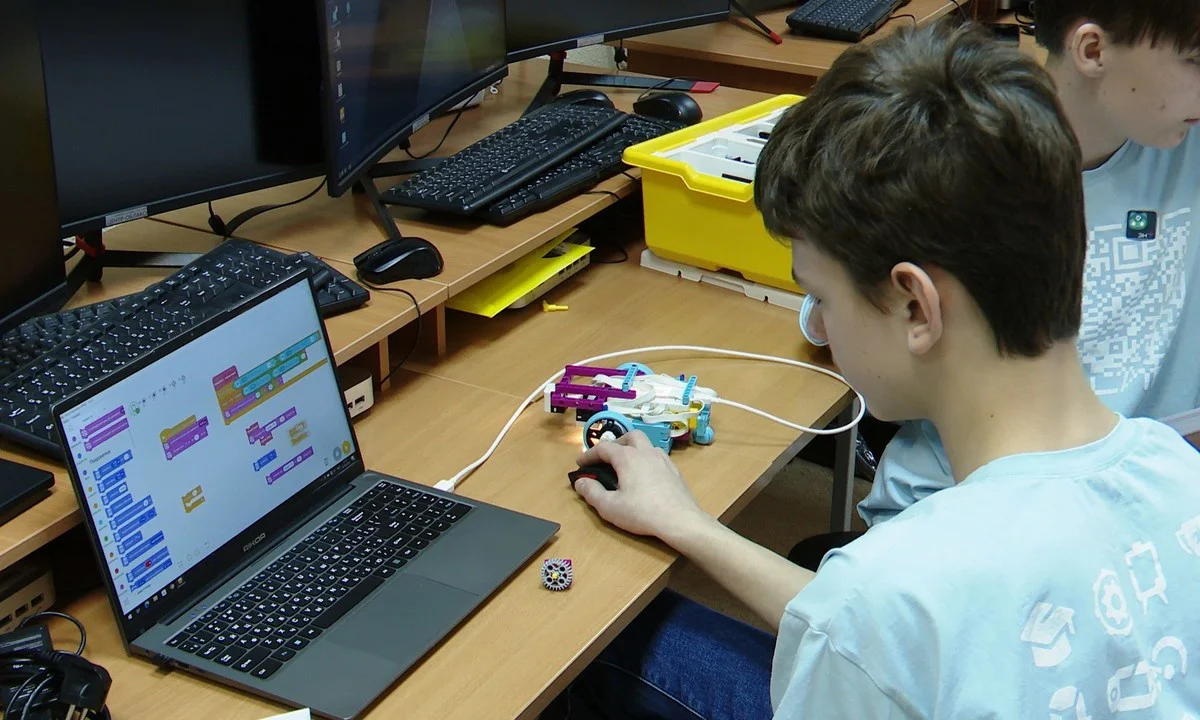
A robotics activity at the Science and Robotics Festival jointly organised by Bratsk State University, Lyceum No.1 and the city education committee. BST photograph accompanying its 10 February 2026 report. The source does not identify the participants’ school.
2026

Programming at the city festival

A robotics activity at the Science and Robotics Festival jointly organised by Bratsk State University, Lyceum No.1 and the city education committee. BST photograph accompanying its 10 February 2026 report. The source does not identify the participants’ school.

Братская студия телевидения / Bratsk Television Studio · БСТ / BST
© БСТ. Перепубликация с прямой ссылкой / Reuse with a direct source link · Original ↗
1990: a school beside the institute

The lyceum emerged in 1990 in connection with Bratsk Industrial Institute. The initiative linked school preparation with future higher education through advanced subjects and familiarity with university culture. In a 2020 anniversary report, early participants recalled lessons in university rooms and other borrowed premises.

Its technical origins survived in school vocabulary: LT groups and double periods. Sources disagree over the exact founding day, so the confirmed year is used here. The university also records the technical lyceum’s opening in its own history. The institutions share an educational environment while remaining distinct organisations.

Finding a permanent home

Before acquiring a permanent home, the lyceum worked in university rooms, a creativity centre and a former kindergarten. An anniversary account dates its move into a four-storey building on Pogodayeva Street to 1999. This was more than a change of postal address.

A dedicated building supports stable routines: classrooms, timetables, prepared experiments and shared events. Education no longer depends on whichever rooms happen to be available for a particular term. The move helps explain how an initiative connected with the institute became a recognisable environment of its own in Energetik. Current organisational profiles confirm today’s address; old directory addresses should not be used for a visit.

Oleg Polikarpov and Bratsk’s mathematics-and-physics tradition

Oleg Polikarpov is a central figure in the lyceum’s educational history. He participated in its creation, but his work with advanced physics began earlier in Bratsk schools Nos. 18, 41 and 26. The lyceum’s tradition therefore grew from an existing local community of teachers and pupils.

Polikarpov became an Honoured Teacher of the Russian Federation in 1997 and an honorary citizen of Bratsk in 2008. The municipal chronicle connects the latter distinction with a Duma decision of 8 April. These awards recognised sustained educational work. Understanding his contribution also requires looking inside the lesson: how pupils were encouraged to choose challenging problems and carry a solution through.

Learning physics through independent choice

In a 2009 interview Polikarpov described graded problems and a points system based on results pupils had earned. Learners could choose a level of difficulty rather than follow an identical sequence of tasks. Motivation was connected with independent judgement: selecting a challenge became part of the work.

He also discussed laboratory activities for seventh- and eighth-year pupils and a set of 52 electricity experiments. Physics was not confined to formulas on a board. Building a circuit and making a measurement required comparison between calculation and observation. These details describe a teaching tradition more meaningfully than a general claim that someone was an exceptional teacher.

The people carrying the school’s history forward

After Polikarpov’s death in January 2015, director Igor Olekminsky recalled his individual approach and continuing search for new teaching methods. Such testimony reveals a school as a professional community: methods live through colleagues’ conversations, observations and everyday work.

Olekminsky led the lyceum during the development of its engineering projects. Anastasia Voronkova is identified as director in the 2020 anniversary report and in the university’s 2026 festival account. These verified points describe different periods without inventing a complete sequence of heads. They also show continuity: new projects draw on accumulated ways of working even when leadership changes.

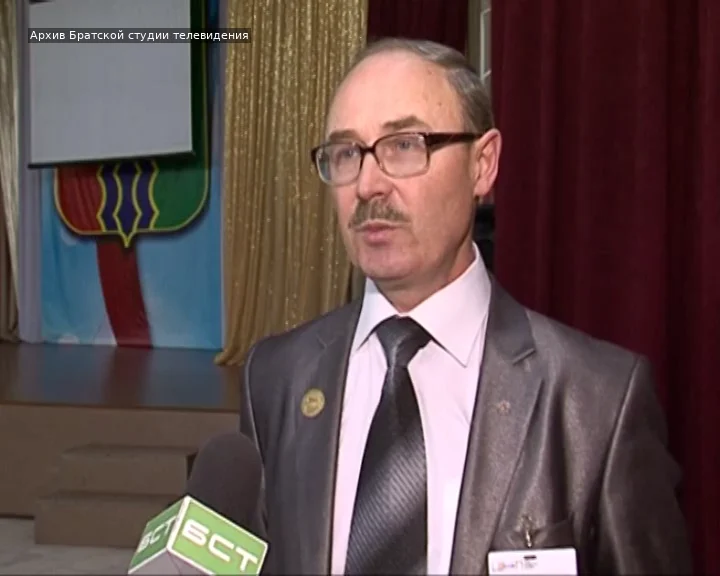
Igor Olekminsky in an archival insert in BST’s report on the School of Real Projects, published on 16 December 2015. His role refers to that period; the insert’s exact filming date is not given.
≤2015

Igor Olekminsky, the lyceum director

Igor Olekminsky in an archival insert in BST’s report on the School of Real Projects, published on 16 December 2015. His role refers to that period; the insert’s exact filming date is not given.

Братская студия телевидения / Bratsk Television Studio · Архив БСТ / BST archive
© БСТ. Перепубликация с прямой ссылкой / Reuse with a direct source link · Original ↗

School of a New Generation

In spring 2012 the university newspaper carried Igor Olekminsky’s account of the lyceum joining School of a New Generation. The report connected it with a Science Day, an educational game, new internet tools and cooperation with RUSAL. It provides a concrete record of early-2010s changes towards project work and collaboration.

The educational task itself was changing. Listening to an explanation was followed by planning, allocating roles, producing an outcome and presenting it to others. Digital tools could support that process without replacing a substantive question. The approach later became particularly visible in engineering competitions based on problems supplied by actual employers.

Long-form educational games

Lyceum teachers date the introduction of long-form educational games to 2012 in a BrSU teaching-methods volume. A scenario is developed for a particular age group, linking preparation, participant roles, the main event and reflection. A game here is a way of organising an extended shared task, rather than simply a break from lessons.

Participants must respond to one another and to the consequences of their decisions. Teachers can observe both the final answer and the group’s process: who suggests an idea, how responsibilities are distributed and what happens when a difficulty arises. Reflection turns the experience back into learning. This differs from a one-off quiz ending with a score.

An outdoor gathering as a shared adventure

The university newspaper recorded a 2014 lyceum outdoor gathering with a space-themed scenario and team tasks. The same issue described the Heart of Baikal summer session, involving a role-based economy, leadership and collaborative projects. These episodes show educational games moving beyond the conventional classroom.

The rhythm changes when pupils must coordinate with a team and act within a shared situation rather than finish an individual exercise. An event may look festive while involving real choices and responsibilities. This is a record of 2014: it illustrates a tradition without implying that the identical programme was repeated every subsequent year.

When ninth-year pupils build their own city

In March 2016 pupils prepared an economic game in which ninth-year students took roles as engineers, builders, bankers and managers. The account mentions drawings and financial plans: their imagined city required coordination between different activities. The scenario suited Bratsk, whose own history connects construction with the organisation of resources.

The learning lies in relationships between decisions. A proposed building must meet the possibility of delivering it; one team’s work affects another. An attractive idea still needs explanation, calculation and agreement. The school model simplifies reality while preserving a central challenge: thinking about an interacting system rather than one isolated action.

Bratsk becomes a learning subject

One scenario described by the teachers was To You, Our City, held for seventh-year pupils in December 2019. It combined Bratsk’s history, landmarks and family memory. Familiar surroundings and a household archive became material for learning.

This changes a pupil’s distance from the past. History becomes a question about one’s own street, family and place in the city as well as events elsewhere. Reliable results require evidence and discussion of what a photograph or recollection actually establishes. The game does not replace research, but provides a reason to begin it and to share discoveries with classmates.

Local history becomes a video project

In the 2025 My Homeland in Names and Lives competition, lyceum entries received first and second places in the Bratsk video-work category. The results were published by the organiser, the museum at the Garmoniya creativity centre. Olga Pronina was named as the pupils’ supervisor.

A technical medium served a humanities subject. A local-history video requires selecting a question, checking information, finding images and constructing a clear narrative. Editing becomes the final link rather than a substitute for investigation. This example broadens the image of a mathematics-and-physics school: urban memory can be a substantial project, alongside mechanisms and software.

An industrial visit begins with a question

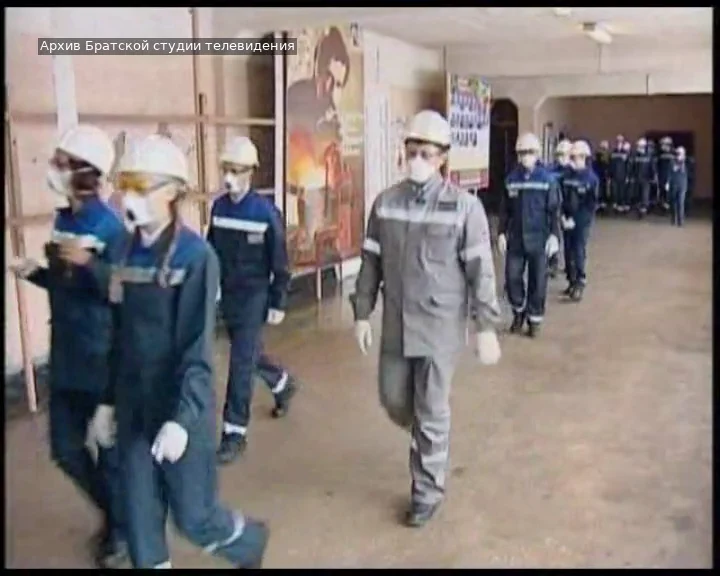
In September 2014 BST filmed lyceum pupils visiting BrAZ’s electrolysis and casting operations. The visit belonged to the School of Real Projects initiative: pupils encountered the enterprise before working on proposed problems. Engineers could explain what needed solving, rather than simply guide an excursion.

That changed the purpose of a factory visit. Observation had to become a question, a question a plan, and a plan an outcome developed over several months. Instead of a prepared textbook answer, pupils faced a real client and practical constraints. Learning began with listening carefully and establishing what would count as a successful solution.

Lyceum No.1 pupils visiting the Bratsk aluminium smelter. A frame from a BST report published on 25 September 2014; the exact filming date is not given.
2014

Lyceum pupils visit BrAZ

Lyceum No.1 pupils visiting the Bratsk aluminium smelter. A frame from a BST report published on 25 September 2014; the exact filming date is not given.

Братская студия телевидения / Bratsk Television Studio · Архив БСТ / BST archive
© БСТ. Перепубликация с прямой ссылкой / Reuse with a direct source link · Original ↗

A model for cutting aluminium ingots

A December 2015 report recalled an outcome from the first season: pupils presented BrAZ engineers with a robotic model for automating aluminium-ingot cutting. It provides a specific example of observation becoming an educational prototype. The plant subsequently proposed further industrial topics.

A model and an industrial installation involve different responsibilities. The report establishes a demonstration to engineers, not deployment on a working production line. Its educational value remains clear: pupils had to understand an operational sequence and express it through a mechanism and programme. The result could be shown, discussed and improved rather than existing only as an essay about a future profession.

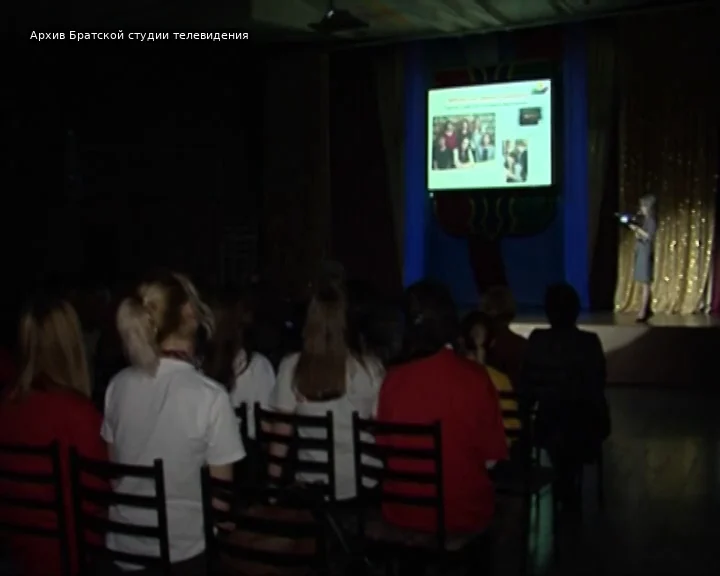
Presenting project challenges at the fair. A frame from BST’s report published on 16 December 2015. The event is held at the Palace of Arts in Energetik, rather than inside the lyceum building.
2015 · публикация / publication

The School of Real Projects fair

Presenting project challenges at the fair. A frame from BST’s report published on 16 December 2015. The event is held at the Palace of Arts in Energetik, rather than inside the lyceum building.

Братская студия телевидения / Bratsk Television Studio · Архив БСТ / BST archive
© БСТ. Перепубликация с прямой ссылкой / Reuse with a direct source link · Original ↗

Light, aluminium foam and clean water

A 2018 report lists strikingly different topics: lighting for rooms and plants, aluminium foam, removing petroleum products from water and automated turbine-blade repair. School engineering extended beyond a single robot model. Each problem involved different materials, conditions and ways of checking an outcome.

The working cycle remained recognisable: understand the problem, allocate tasks, consult a mentor and present a solution. Industrial context gave physics, chemistry and mathematics a practical purpose. A project could end with research or a prototype; industrial use required further testing. The story concerns pupils’ first engineering experience, rather than an invented claim that a school device immediately transformed an entire industry.

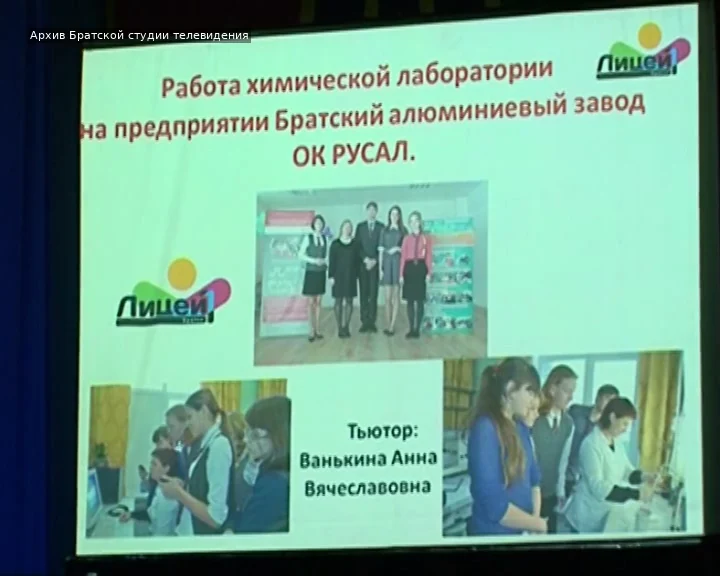
A slide about working in the BrAZ chemical laboratory, shown in BST’s report on the lyceum’s School of Real Projects. Published on 16 December 2015; the original slide is not precisely dated.
≤2015

A chemical laboratory as a learning project

A slide about working in the BrAZ chemical laboratory, shown in BST’s report on the lyceum’s School of Real Projects. Published on 16 December 2015; the original slide is not precisely dated.

Братская студия телевидения / Bratsk Television Studio · Архив БСТ / BST archive
© БСТ. Перепубликация с прямой ссылкой / Reuse with a direct source link · Original ↗

A robot for examining a dam surface

In 2023 lyceum pupils presented a robot project for examining the surface of Bratsk HPP’s dam and mapping cracks. The report discusses water pressure, streamlined movement and surface growth, placing the mechanism within a physically constrained environment. Motion alone was insufficient: the team had to consider interaction with the structure and water.

This was an educational project, not proof of operational deployment at the dam. Its interest lies in the engineering questions: what data are needed, how measurements relate to positions, and what obstructs movement or observation. The example connects a school with the city’s defining structure without exaggerating the development’s readiness.

From a school initiative to a city competition

By the tenth School of Real Projects competition in 2023, ninety participants from nine educational organisations were involved. Technical, humanities and social sections discussed their work. An initiative associated with the first lyceum and university had become a meeting place for several schools and partners.

The organisers now list the dam, industrial and infrastructure companies, the Serbsky library and other organisations as partners. More than one hundred projects accumulated across the programme’s history; that is a programme-wide total, not the output of the lyceum alone. The platform presents the city as a network of real questions requiring technical, investigative and social work.

The festival enters the university

The programme for the university–lyceum festival in February 2018 included robot football, Robot in a Bag, skittle-ring tasks, trajectory challenges and robotic manipulators. The university setting could bring together pupils with different experience and several forms of engineering activity.

A competition makes the outcome visible: a device must perform under specified conditions. Behind a short performance lie assembly, adjustment and repeated attempts. Visitors encounter that process through the festival. The 2018 programme is an announcement, however: it establishes the intended format rather than a verified list of eventual winners.

Engineering beyond the construction kit

The 2019 programme extended beyond robots to a hydraulic-excavator simulator, three-dimensional printing and modelling software. The combination broadened engineering beyond an individual construction-kit model. Digital design, a physical device and its control appeared as connected parts of a problem.

Collaboration between the lyceum and BrSU made those relationships accessible. A pupil might operate a virtual mechanism before considering how it works or how a component could be designed. In a city with construction, machinery and energy professions, this also provided an early encounter with the local professional environment.

From LEGO to autonomous transport

At the eleventh festival on 17 February 2024, LEGO WeDo and Scratch appeared alongside Young Engineer, autonomous transport and FIRST Tech Challenge. Participants’ ages and task complexity varied. The different formats offered a route from accessible construction towards more independent engineering.

The report records specific lyceum results: ST-SM won the fifth-year Young Engineer category, Gromoverzhtsy received a second-level award in that category, and Chislo Pi a third-level award in autonomous transport for years six and seven. These were achievements in distinct disciplines, rather than a single overall first place across the festival.

Two buildings, a gym and 1,500 visitors

On 7 February 2026 the festival occupied two BrSU teaching blocks and its gym. The university reported more than 1,500 visitors. The education committee, Lyceum No. 1 and BrSU organised it, with Transneft East as general partner. This describes a city event, not the enrolment of one school.

BST reported participation by 53 educational organisations from nine municipalities. Pupils, teachers, the university and employers met on a shared platform. Photographs therefore show a collective setting: not every child pictured can automatically be identified as a pupil of Lyceum No. 1. The distinction preserves the lyceum’s real contribution as a co-organiser.

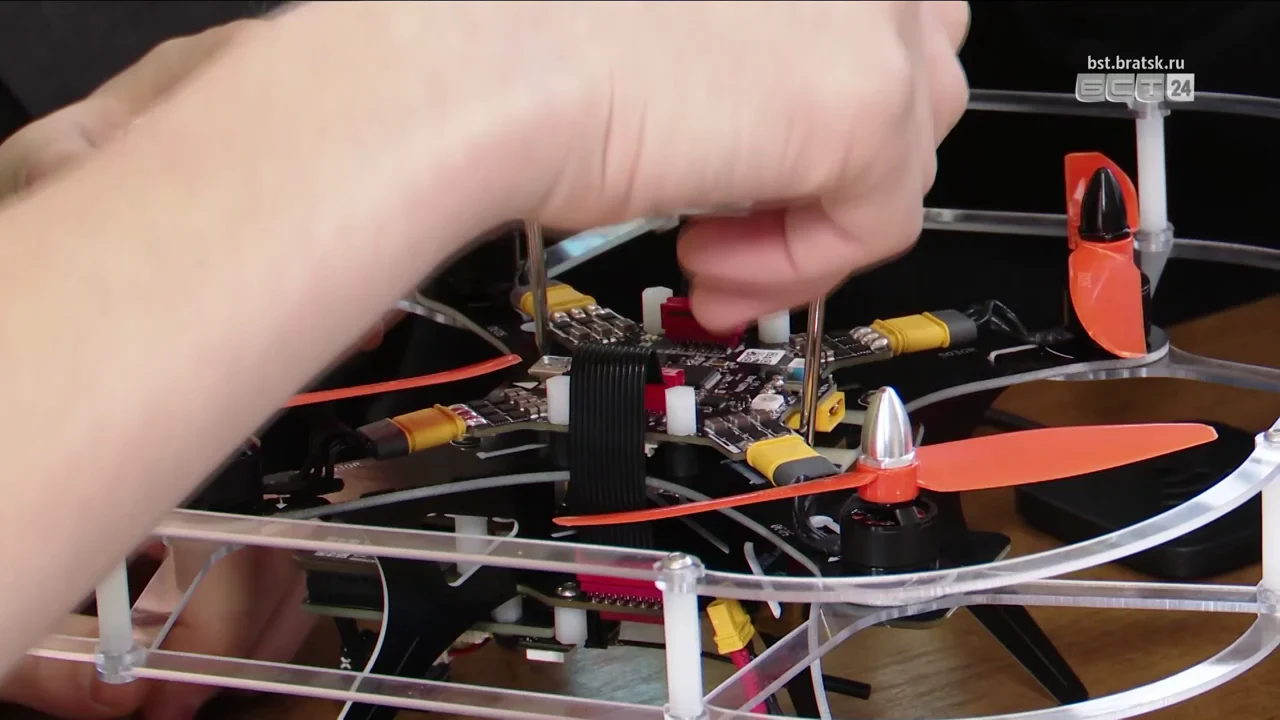
Assembling a drone at the Science and Robotics Festival at Bratsk State University. A frame from BST’s own report published on 10 February 2026. This illustrates the joint city event and does not attribute the project to Lyceum No.1.
2026

Building a drone at the 2026 festival

Assembling a drone at the Science and Robotics Festival at Bratsk State University. A frame from BST’s own report published on 10 February 2026. This illustrates the joint city event and does not attribute the project to Lyceum No.1.

Братская студия телевидения / Bratsk Television Studio · БСТ / BST
© БСТ. Перепубликация с прямой ссылкой / Reuse with a direct source link · Original ↗
Research involves more than robots

The first lyceum’s 2026 festival projects included pioneer camps in periodicals from 1950–1990, Bratsk’s honorary citizens, oil sorbents made from local materials and responsible consumption. History, environmental chemistry and everyday habits met within the same school setting.

They share a dependence on evidence: newspaper archives, biographical records, material properties or observation. Outcomes depend on the clarity of the question and the suitability of the method. These examples show that an engineering reputation need not exclude other disciplines. Project skills can serve different subjects when a striking title does not replace proof.

Tesla in Minsk

At the League of Engineers championship in Minsk on 27–29 March 2026, the lyceum’s Tesla team won the Control Systems category. The report names mentors Egor Losev, Olga Chetvertakova and Evgeniya Tanaeva. Both the competition and the precise category matter.

Control is a distinct part of robotics: assembling a mechanism must be followed by coordinating its behaviour with a programme and task. Competition makes that work public and comparable with other solutions. Winning a category is not an overall championship across every discipline, but it provides a specific example of the lyceum’s engineering education reaching an international arena.

Super Brothers and Inquisitive Minds

At Krasnoyarsk 7.0 on 16–19 April 2026, the lyceum’s Super Brothers team won the Inquisitive Minds category. This is another result best described in the competition’s precise terms rather than converted into a vague claim of being best at everything.

Different awards recognise different aspects of teamwork, from a mechanism’s performance to investigation and explanation. For the school’s history, such journeys connect continuing work between lessons, the local festival and external championships. An award is not produced on presentation day alone: preparation, role allocation and repeated testing come first.

The Stepan Pogodayev museum

The lyceum has a historical and memorial museum named after Stepan Pogodayev. A 2026 report identifies Natalya Ubaseva as its head. A school museum offers another way of approaching the past: preserving material, considering its provenance and constructing an account for visitors, alongside reading textbooks.

In the sixth Know in Order to Remember competition it placed third in the Siberian Federal District’s Best Urban Museum category and received a 200,000-rouble development certificate. This was a specific district-level award in a defined category, not third place among all Russian museums. It recognised an important part of the school’s work with historical memory.

Volunteering the Bratsk way

The lyceum’s official DOBRO.RF profile presents a volunteer movement called Dvizh po-Bratski. It also describes campaigns, family outdoor gatherings, educational games and the science-and-robotics festival. Such activities broaden a pupil’s role from receiving assignments to participating in a shared undertaking.

Volunteering involves a different measure of success from a test paper. Practical usefulness, agreement with other people and completing a commitment matter. It connects educational skills with responsibility towards the city and community. The public profile makes this activity visible, while the profile’s registration date remains distinct from the school’s founding date.

What the regional RAEX ranking shows

RAEX ranked Lyceum No. 1 sixth in Irkutsk Region for graduate competitiveness in 2024, third in 2025 and sixth in 2026. These are positions within one region and one ranking category, published in the respective years.

The sequence shows the school near the top of the regional table without explaining every change in position. Cohort composition and recorded university admissions influence results. Families can consider a ranking alongside programmes, workload, a child’s interests and the school environment. It should not be read as a promise of an identical outcome for every future pupil.

Competitiveness and other measures

RAEX’s 2026 method uses 2024 and 2025 admissions to 49 principal universities from its relevant leading-university list. Competitiveness weights admissions and normalises them for the size of a school’s graduating cohort. It differs from a simple absolute admissions total and does not cover every aspect of school life.

A separate natural-science, mathematics and technical ranking placed the lyceum eighth in the region in 2021. That figure should not be inserted directly into the 2024–2026 competitiveness series. Methods must be compared before a trend can be discussed. Precision makes the school’s achievements more meaningful rather than less important.

The lyceum within the regional education system

Irkutsk Region education ministry order No. 55-850-mr of 7 July 2025 lists Lyceum No. 1 as a participant in the School of Russia’s Ministry of Education project. It uses the school’s ordinary municipal name. The official record helps distinguish it from similarly numbered institutions elsewhere and adjacent entries in the document.

Participation in a programme and winning a competition describe different things. One concerns institutional development; the other records a particular competitive outcome. Both scales belong in the school’s history. Everyday educational renewal attracts less attention than an award ceremony, yet it creates the setting in which future projects develop.

The next School of Real Projects season

As checked on 19 October 2026, organisers reported that the case fair had taken place on 9 October in BrSU’s first teaching block. Applications for 2026/27 close on 26 October. Work with teachers and industry mentors is planned through March, with submissions due by 26 March 2027 and the final conference scheduled for 16 April.

This is a forward calendar, not a report of a completed final. It shows an extended task unfolding over months, from encountering a case through development to presentation. Participation details and changes should be checked with the organisers. The article preserves a dated view of the programme connecting the lyceum, university and city partners.

Useful links

Bratsk State University: the full history ↗School of Real Projects: organiser website ↗The lyceum on DOBRO.RF ↗RAEX ranking: the 2026 source ↗Energetik: neighbourhood history ↗BST video: lyceum projects, 2018 ↗BST video: the science and robotics festival, 2026 ↗

Sources & further reading

Checked on 19 October 2026. The history continues beyond 1991; competition results, rankings and offices retain their dates and categories. Sources disagree over the exact founding day, so the confirmed year 1990 is used. The old brlic.ru domain is not presented as a current school website. The 2026/27 plans are distinguished from completed events. Arrange school or museum visits with the administration.